
Stretch Mark Camouflage Treatment
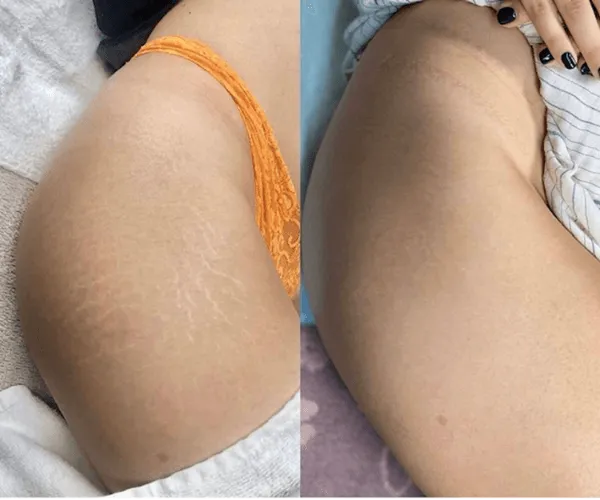
If you have had previous surgery, been involved in an accident or have stretch marks, we can disguise these with medical camouflage. Although we do endorse being happy in your skin and being proud of your stretch marks, we understand it can affect people’s confidence. The medical camouflage procedure is a form of micropigmentation. Pigments are carefully selected and mixed to match your surrounding skin tone and inserted into the deeper layers of skin using a needling device to correct the colour, making scars or stretch marks appear less visible.
Stretch Mark Camouflage Treatment
If you have had previous surgery, been involved in an accident or have stretch marks, we can disguise these with medical camouflage. Although we do endorse being happy in your skin and being proud of your stretch marks, we understand it can affect people’s confidence. The medical camouflage procedure is a form of micropigmentation. Pigments are carefully selected and mixed to match your surrounding skin tone and inserted into the deeper layers of skin using a needling device to correct the colour, making scars or stretch marks appear less visible.
What is stretch mark tattoo camouflage?
The medical camouflage procedure is a form of micropigmentation. Pigments are carefully selected and mixed to match your surrounding skin tone and inserted into the deeper layers of skin using a needling device to correct the colour, making scars or stretch marks appear less visible.
It is worth noting that stretch mark camouflage doesn’t always require a colour pigment. There are some techniques that involve using specialised microneedling to stimulate collagen production in the affected areas. This process can help to smooth out the skin’s surface and reduce the appearance of stretch marks without the need to add any coloured pigment to the skin.
Please note the aim of this procedure is not to remove any scars or stretch marks but to camouflage them to the skin.
What kinds of stretch marks or scars can you treat?
It is vitally important that the scars or stretch marks are lighter than the overall skin tone and not raised. The scars or stretch marks need to be “healed” and usually 2 years+ old. Stretch marks and scars cannot be red as this indicates the scar or stretch mark hasn’t fully healed.
If they are red you may benefit from some MCA needling sessions which can gradually lighten or soften the scar/ stretch marks. Some clients may require 2-3 sessions of MCA needling prior to the insertion of pigment which we can advise during your consultation.
An advantage of this treatment is that it is suitable for people who are religious or who do not wish to have tattoos. This is because the technique does not involve creating a traditional tattoo with permanent ink. Instead, the goal is to create the appearance of natural, even skin tone using specially designed pigments or collagen stimulation.
How does stretch mark tattoo camouflage work?
The process of stretch mark tattoo camouflage typically involves an initial consultation with a trained professional. During this consultation, the individual will discuss their goals and concerns with our therapist, who will then recommend the best course of treatment based on your individual’ skin type and other factors.
On your first session we will carefully select skin tone pigments and mix them together using a mixing solution that can prevent colour change. This pigment is then inserted into the skin using a needle device much like what is used for semi-permanent make up application. A colour match test is performed on a small area to see how the pigment takes in the skin; this can usually take up to 60 days for full healing.
After this time, you will return to the clinic and your first full session will take place. We will mix the selected pigments and proceed with your treatment. You may need 2-3 sessions every 60 days to achieve the full results.
FAQ's
What is MCA needling?
MCA (Multitrepannic collagen actuation) is a treatment that involves the same steps as medical camouflage but without the use of any pigments. This can promote healing of the scar/ stretch marks if they are not yet fully healed or they dip slightly lower than the surrounding skin. Occasionally this may be all that is needed and sometimes this is carried out prior to the insertion of pigments.
How long does the procedure take?
The session can take anywhere between 1-3 hours depending on the size of the area being treated. For very large areas we wouldn’t advise having this carried out in 1 sitting and would need to book you in for 2 separate visits.
Please note that mixing the pigments can take around 30 minutes before the procedure starts. We can advise how long we would expect the area to take during your initial consultation.
Am I suitable for the stretch mark camouflage treatment?
You would not be suitable for the treatment if any of the following applies to you.
- Pregnant
- Breastfeeding
- Keloid scars
- Localised skin infections
- Skin allergies (allergic to pigment, titanium dioxide or chromium)
- Recent laser treatment
- Raised moles (We cannot treat over moles)
- Skin cancer
- Psoriasis
- Haemophilia/ blood disorders
- Very light/ fair skin
Is this treatment suitable for all skin types?
Yes, we treat Fitzpatrick 1-6, although if you are very pale this can be harder to colour match as this skin can almost appear translucent. For skin types that are prone to keloid scarring this treatment wouldn’t be recommended. On darker skin types and if you suffer with hyperpigmentation, there is a risk that the healed area can stay darker beyond the 60 days. This is why a colour match test is recommended to gage the healing process.
Is the treatment safe?
In short yes. You must ensure the practitioner carrying out the treatment is fully trained and the premises you are attending is following guidelines to ensure your health and safety. The pigments can contain elements of some metals which have been proven to be safe in the skin including chromium and titanium dioxide (which are commonly found in most SPF’s) If you have any known allergies to these you would be unsuitable for treatment.
Do I need a patch test?
Yes. We will ensure you have had a patch test during your consultation, or we can post this out to you.
Does it hurt?
As the needles penetrate the skin it can cause some minor discomfort however many clients liken it to a scratchy sensation like microneedling. We do not advise a numbing cream for treatment as we wouldn’t want this to affect the pigments in any way. You can take paracetamol prior to treatment but not aspirin as this can thin the blood and cause clotting at the treatment site.
How long do the results last?
This is classed as a permanent procedure much like other forms of pigment insertion like microblading or semi-permanent make up. However, as the pigment is diluted considerably to match skin tones, we would usually advise it lasting from 3-7 years on average. You will find the pigment will slowly fade over time and will differ from person to person depending on immune systems, sun exposure, adherence of aftercare and general healing.
What can I expect after my session?
You may be a little sore, red and swollen which is perfectly normal. This will settle usually within 7-14 days and the skin will then appear dark and scabby. As the skin heals it can appear darker for some time until the skin heals and reveals the final result. Results after the first session can vary quite a bit, some clients will notice a significant improvement and some will not notice much, this is why 2-3 sessions are recommended.
Please note that session 1 is always carried out more cautiously to avoid any over pigmenting of the skin. On your second session the practitioner will be able to assess if any colour adjustments are required and we can then build the pigment up further. Please be patient as this is a multi-treatment procedure.
Is there any downtime?
Initially after treatment you will be red and swollen at the treatment site which is completely normal. You will need to continue to apply a cold compress the area at home to induce the healing. You can go to work however we would advise avoiding any exercise for 7 days.
Are there any Aftercare instructions?
- Clients can never have any laser treatment over the area, this will cause the pigment to turn black
- Cold compress on the treatment area, 3 times a day for first few days to speed up healing process
- Do not shower for 24 hours, after this it can be a lukewarm shower
- You cannot go in water for at least 14 days following treatment. This includes baths, swimming pools, saunas, steam room, Jacuzzis etc.
- No vigorous exercise for 2-3 weeks post treatment
- Do not touch the area for 2-3 weeks apart from applying aftercare lotions
- Do not pick/ scratch or exfoliate the area. Doing so will cause scarring or loss of pigment
- No other treatments in the area for 60-90 days –
- No treatments that you can’t do over tattoos ever
- No sunbeds or sun tanning in the treatment area for at least 60-90 days as this can cause the pigment to fade faster
How long before I see the final result?
The final result can take up to 60 days post treatment (sometimes longer for darker skin types). Remember that you will require 2-3 sessions. Taking good care of the treated area can induce healing quicker.
What is the non-pigment version of stretch mark tattoo camouflage?
The non-pigment version of stretch mark tattoo camouflage involves using specialised tattoo microneedles to stimulate collagen production in the affected areas, without adding any pigment to the skin.
How does non-pigment stretch mark tattoo camouflage work?
Non-pigment stretch mark tattoo camouflage works by creating tiny punctures in the skin, which triggers the body’s natural healing response and stimulates the production of collagen. This can help to smooth out the skin’s surface and reduce the appearance of stretch marks.
Can I have this treatment if it's against my religion to have tattoos?
Yes, you can have non-pigment stretch mark tattoo camouflage treatment even if it is against your religion to have tattoos. Non-pigment techniques do not involve adding any permanent ink to the skin, so they are often considered a suitable option for individuals who have religious or personal objections to traditional tattooing.
The goal of the treatment is to create the appearance of natural, even skin tone, rather than to create a traditional tattoo. It’s important to discuss any concerns you may have with our qualified practitioner before undergoing the treatment to ensure that it aligns with your beliefs and values.